

Some of the biggest blockbusters and most beloved classics are war movies. It’s a genre that always seems to fascinate people, for understandable reasons. However, there are also plenty of great war films that are not as famous or successful, but which are certainly still worth checking out.
The titles on this list look at war from unusual angles: through the eyes of children, reluctant soldiers, opportunists, or men trapped inside systems they cannot escape. These films may lack the scale or recognition of bigger titles, but they often offer something far more intimate and unsettling.
‘The Bridge’ (1959)
“You must hold the bridge at all costs!” Set in the final days of World War II, The Bridge follows a group of German schoolboys who are conscripted into the army as the Third Reich collapses. Filled with naive patriotism and a desire to prove themselves, they are assigned to defend a small, strategically meaningless bridge. However, reality soon shatters all their illusions. Gunfire rains down, and casualties mount. Director Bernhard Wicki, a major figure of German postwar cinema, builds this premise into a harrowing anti-war statement, critiquing military propaganda in particular.
It’s also simply a tragic coming-of-age story, a portrait of innocence destroyed. At the beginning, the boys treat war as an adventure, but in the end, it’s little more than a nightmare. There are no grand victories for them; only confusion, fear, and irreversible loss. The combat is chaotic, frightening, and stripped of glory. The aesthetic is restrained and realistic, making the message hit all the harder.
‘Overlord’ (1975)

“I’ll probably be dead before tomorrow.” Overlord is another bleak but powerful World War II movie, full of food for thought. It centers on Tom Beddows (Brian Stirner), a young British soldier preparing for the D-Day invasion during World War II. Through a mixture of dramatized scenes and archival footage, the film traces his journey from basic training to the eve of the Normandy landings. A sense of inevitability hangs over him the whole way through. From early on, it feels as though Tom’s fate is already sealed.
The film’s style reinforces this unsettling mood. The fusion of news clips and a fictional plot is effective, reminding us that these events were very real. While Tom himself is a creation by the writers, he’s an everyman character, serving as a stand-in for countless young troops who were thrust into this war. Through him, Overlord examines World War II from a more meditative, philosophical perspective than one normally sees, less concerned with action than emotion.
‘Play Dirty’ (1969)

“In war, truth is the first casualty.” Michael Caine leads this one as Captain Douglas, a cynical British officer assigned to lead a group of misfit commandos on a dangerous mission behind enemy lines in North Africa during World War II. Their objective is to destroy German fuel depots, but internal rivalries and shifting loyalties threaten the operation from within. In particular, Douglas clashes with the rough, pragmatic Captain Cyril Leech (Nigel Davenport), a man with very different views on discipline and honor.
This setup becomes a tense men-on-a-mission movie in the vein of The Dirty Dozen, but with some class politics and social tensions thrown in. Indeed, Play Dirty is very much a genre movie, but one that frequently subverts audience expectations. It gets unusually bleak as it rolls along, and the characters are a little more complex than one might expect. Caine, as always, elevates his part, convincingly playing someone whose idealism is eroding in contact with reality.
‘My Way Home’ (1965)

“I don’t understand what you’re saying.” My Way Home is a lyrical Hungarian drama about a young boy (András Kozák) who escapes from a prisoner-of-war camp and attempts to make his way home across a war-torn countryside. Along the way, he forms a fragile, wordless connection with a Russian soldier (Sergei Nikonenko), despite the fact that they cannot understand each other’s language. Their bond becomes a quiet act of defiance against division.
Indeed, the film’s focus is on the possibility of human connection, even across the widest cultural and ideological chasms. It’s an anti-war movie that offers a few glimmers of hope. By removing traditional elements like battles and action, director Miklós Jancsó highlights the loneliness, fear, and randomness that often define the wartime experience. However, even in this grim environment, friendship is possible. The storytelling is fittingly minimalist: dialogue is obviously sparse, and much of the narrative unfolds through movement, silence, and observation.
‘Lacombe, Lucien’ (1974)

“I didn’t choose anything. It just happened.” This war drama was directed by Louis Malle, the filmmaker behind Au revoir les enfants and My Dinner with Andre. The title character (Pierre Blaise) is a bored and directionless French teenager living in rural France during the Nazi occupation. After being rejected by the local Resistance, he impulsively falls in with a group of collaborators working with the German authorities. From there, he becomes increasingly involved in their activities, not out of ideology, but out of convenience, curiosity, and a desire for belonging.
Blaise does a fine job in his role, fleshing the character out and making him feel strikingly real. He and Malle lean into Lucien’s messiness and complexity, as well as his ordinariness. He is passive and often morally indifferent, making some of his actions later in the film all the more disturbing. Through him, the movie raises uncomfortable questions around apathy and how easy it is to participate in oppressive systems.
‘Fires on the Plain’ (1959)

“I have nothing left to eat.” This Japanese film follows Private Tamura (Eiji Funakoshi), a soldier wandering through the Philippines during the final stages of World War II. Sick, starving, and abandoned by his unit, Tamura is left to fend for himself in a landscape where survival becomes increasingly desperate. He searches for food while encountering other soldiers who have been reduced to the same wretched state. What follows is a deeply grim study of war’s ugliest elements.
The realism is unflinching — Fires on the Plain shows us corpses, abandoned villages, and starving men, all of it disturbingly convincing. However, there are also occasional poetic moments amid the bleakness, and certain objects (like salt and a grenade) take on symbolic weight. This anti-war movie is psychologically intense, too. As Tamura’s condition worsens, the line between sanity and madness begins to blur. His journey becomes not just physical but existential, raising questions about what it means to remain human in extreme conditions.
‘The Train’ (1964)

“Art belongs to France.” The Train is an action-thriller directed by John Frankenheimer, best known for The Manchurian Candidate and Ronin. During the final days of World War II in Nazi-occupied France, a German officer (Paul Scofield) is obsessed with transporting stolen French art treasures back to Germany before the Allies arrive. Opposing him is our protagonist, a reluctant French Resistance railway inspector (Burt Lancaster), who is drawn into a dangerous mission to stop the train.
Both lead actors are strong here, and their dynamic is compelling. The German officer, in particular, is more interesting than your average baddie, driven by a genuine desire to preserve art, though one that takes twisted and pathological forms. On the directing side, Frankenheimer keeps the pace brisk and the tension high, serving up several killer set pieces using real locomotives and practical effects. The train crashes, explosions, and sabotage operations feel tangible, which is a key reason the movie works.
‘The Hill’ (1965)

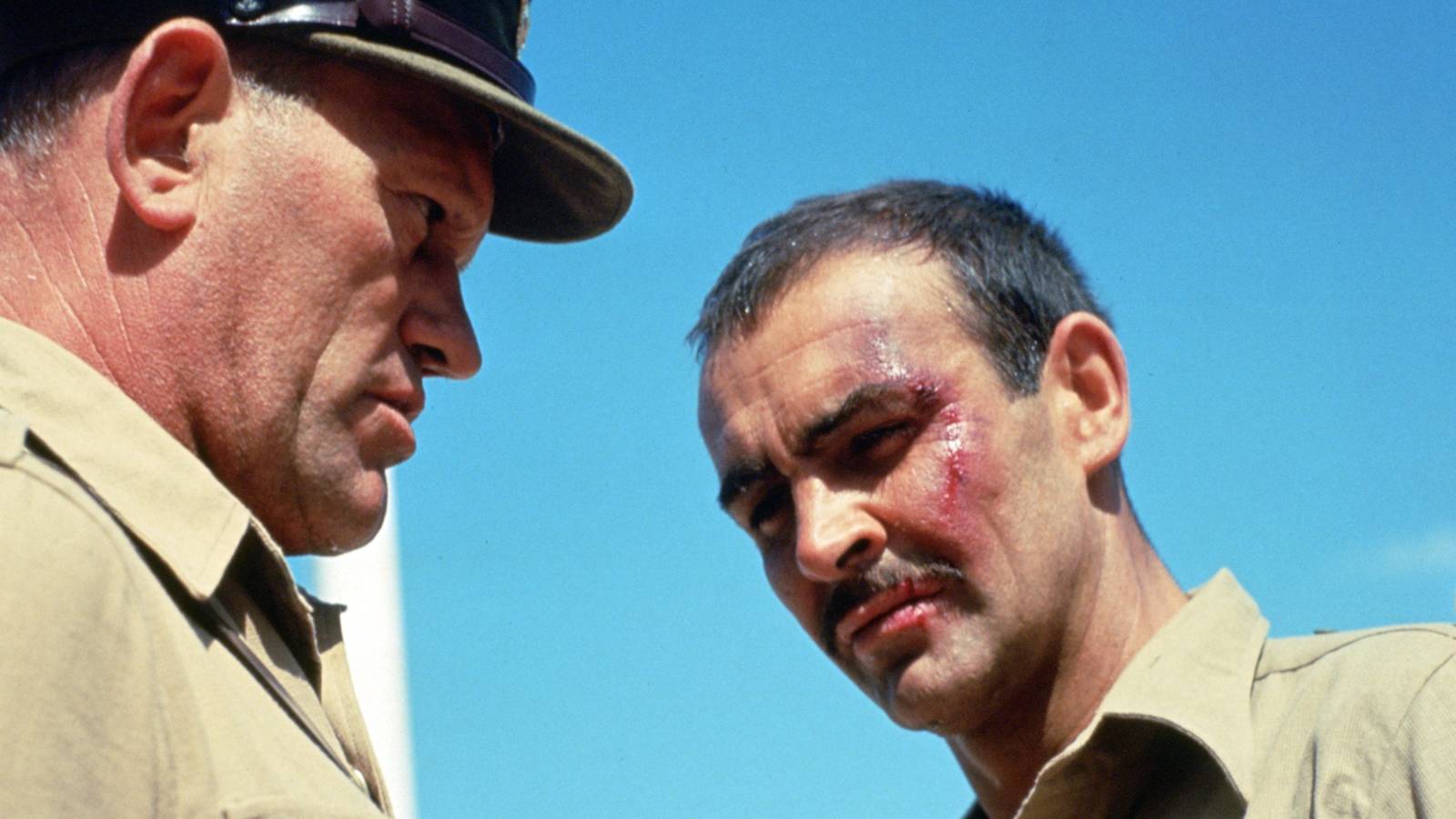
“This place breaks men.” The great Sidney Lumet made this one, though it’s not as well-remembered as his classics like 12 Angry Men or Dog Day Afternoon. The Hill unfolds inside a brutal British military prison camp in North Africa during World War II. There, soldiers who have committed disciplinary offenses endure harsh punishments at the hands of sadistic officers. Cruelest of all, they are forced to repeatedly climb a man-made hill under the scorching sun, a Sisyphean task meant to break their spirits.
At the center of all this is Joe Roberts (Sean Connery), a defiant prisoner who resists the authority of the guards. The focus here is very much on psychology. The central conflict is not between opposing armies, but between individuals and an oppressive authority structure. Lumet does a great job of conveying the emotional strain the characters are under, leaning into close-ups, stark lighting, and claustrophobic framing. The atmosphere is harsh but immersive.
‘Cross of Iron’ (1977)

“We’re here to kill Russians.” This lean, mean movie from Sam Peckinpah, the master of brutal cinema, bucks convention by having German soldiers as its main characters. Set on the Eastern Front, Cross of Iron follows a unit of German soldiers fighting against overwhelming Soviet forces. They include Sergeant Rolf Steiner (James Coburn), a hardened and pragmatic soldier who cares deeply about the men under his command. He clashes with Captain Stransky (Maximilian Schell), an ambitious officer obsessed with winning the Iron Cross for personal glory.
The film is intense and hardcore, with disorienting action sequences defined by mud, confusion, and deafening explosions. These scenes are frequently absurd, as well, with Peckinpah often juxtaposing moments of brutality with images that highlight its futility. Finally, on the thematic side, Cross of Iron is surprisingly ambiguous and intelligent. It avoids simple notions of good versus evil and instead highlights the shared suffering of individuals caught in a destructive system.
‘The Steel Helmet’ (1951)

“War isn’t what you think it is.” Sergeant Zack (Gene Evans) is an American soldier during the Korean War who survives an ambush and joins a small group of soldiers attempting to reach safety. Along the way, they must contend with enemy forces, unreadable civilians, internal tensions, and tough moral dilemmas. The movie was made on a low budget and tight schedule, which actually works to its benefit, giving everything a raw and urgent feel. At times, it almost seems like a documentary.
Plus, The Steel Helmet deserves credit for being thematically bold at a time when the Korean War was still underway. For instance, the film doesn’t hold back when it comes to critiquing ideological contradictions or racial tensions within the military. This approach was a break with most war movies of the 1950s, which tended to be patriotic and fundamentally upbeat. All in all, The Steel Helmet is a tense, smart movie that has aged well.
Source link
